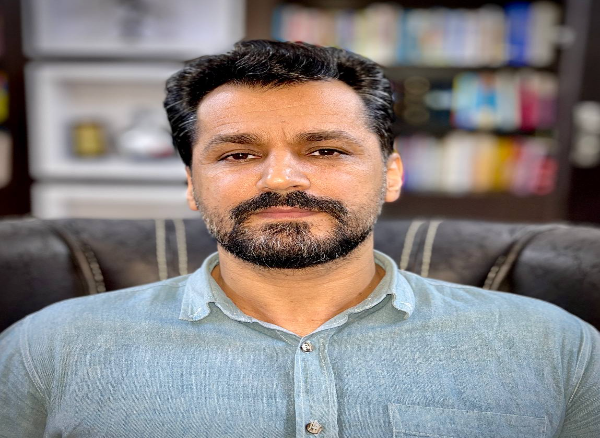
دکتر علی پژوهنده(مسئول فنی)
سوابق تحصیلی :
دکترا : روانشناسی تربیتی
کارشناسی ارشد : روانشناسی عمومی
کارشناسی : روانشناسی بالینی
روان درمانی تحلیلی
Ali Pajoohandeh, PhD
Curriculum Vitae
Psychoanalytic Psychotherapist | Founder and Director, RavanPajooh Psychoanalytic School
Ravan-Pajooh Psychoanalysis School
Founded and directed by Dr. Ali Pajoohandeh
Psychoanalytic education, seminars, and clinical supervision in Mashhad, Iran.
Official website: https://www.ravanpc.ir/
Updated August 2026
|
Contact Email: apajoohandeh@gmail.com Phone: +98 915 482 1187 Website: www.ravanpc.ir Location: Mashhad, Razavi Khorasan, Iran |
Current Institutional Roles Founder and Managing Director, Ravan-Pajooh Counselling Centre, Mashhad, Iran Founder and Director, RavanPajooh Psychoanalytic School, Mashhad, Iran Psychoanalytic Psychotherapist, trained at Tehran Center for Psychoanalytic Studies (TCPS) IAGP Member |
Professional Profile
Ali Pajoohandeh is a psychodynamic and psychoanalytic psychotherapist based in Mashhad, Iran. He is the founder and director of RavanPajooh Psychoanalytic School and the founder and managing director of Ravan-Pajooh Counselling Centre. He holds a PhD in Educational Psychology from Kharazmi University of Iran and graduated as a psychoanalytic psychotherapist from the Tehran Center for Psychoanalytic Studies (TCPS). His clinical, teaching, and research work focuses on trauma, subjective temporality, object relations, psychic protection, and the relation between being and time in psychic life. He is the developer of To Be-Analysis, within which he has formulated the concepts of the open linguistic past, the Zurvan Object, the burden of being, and a four-layer model of the protective shield. He is also the developer of Analytic Group-Vision (AGV), a matrix-based model of psychoanalytic group supervision.
Education and Psychoanalytic Training
- PhD in Educational Psychology, Kharazmi University of Iran, Tehran, Iran.
- Psychoanalytic Psychotherapist, Tehran Center for Psychoanalytic Studies (TCPS), Tehran, Iran. Formal psychoanalytic training leading to graduation as a psychoanalytic psychotherapist.
- Long-term independent psychoanalytic study and research beginning in the early 2000s, with formal psychoanalytic training beginning in 2010 and advanced training through TCPS from 2015; qualified as a psychodynamic/psychoanalytic psychotherapist in 2021.
Professional Positions and Institutional Leadership
- Founder and Managing Director, Ravan-Pajooh Counselling Centre, Mashhad, Iran, 2008-present.
- Founder and Director, RavanPajooh Psychoanalytic School, Mashhad, Iran, 2016-present.
- Instructor in Psychoanalysis, Tehran Center for Psychoanalytic Studies (TCPS), Tehran, Iran, 2018-present.
- Instructor in Psychoanalysis, RavanPajooh Psychoanalytic School, Mashhad, Iran, 2016-present.
- Organizer and conductor of psychoanalytic journal clubs, 2018-present.
- Psychodynamic and psychoanalytic clinical practice with adults, including long-term individual psychotherapy, consultation, and psychoanalytic supervision.
Clinical Work and Supervision
- Clinical work in psychodynamic and psychoanalytic psychotherapy, with particular attention to transference, countertransference, frame, temporality, trauma, object relations, and the development of self-experience.
- Clinical teaching and supervision for psychotherapists and candidates through RavanPajooh Psychoanalytic School and related educational programs.
- Developer and conductor of Analytic Group-Vision (AGV), a psychoanalytic model of group supervision organized around the group matrix, the barometer of the matrix, lived clinical experience, and the transformation of supervision from a collection of opinions into a shared analytic field.
- Experience conducting structured psychoanalytic group-supervision meetings for psychotherapists and candidates, including clinical case presentation, matrix-based reflection, and work with parallel processes and frame-related enactments.
Research Expertise Relevant to the Proposed Program
- Psychoanalytic theories of trauma, repetition, and traumatic aftermath
- Subjective temporality and the open linguistic past
- Freud’s theory of time and timelessness
- Beyond the Pleasure Principle, trauma, and the protective shield
- Birth trauma, Otto Rank, and pre-Oedipal theory
- The Zurvan Object and the temporal and protective functions of objects
- To Be-Analysis: being, time, and psychopathology
- The four-layer model of psychic protection and its relation to trauma
- Frame, transference, countertransference, and intersubjectivity
- Psychoanalysis, culture, war, and collective trauma
Major Theoretical Contributions
To Be-Analysis
To Be-Analysis is an integrative psychoanalytic framework developed by Pajoohandeh to explore the relation between being, time, object relations, psychic pain, and psychopathology. It centers on the ways in which the subject experiences the burden of being, the continuity or breakdown of time, and the role of objects in making psychic life bearable.
Open Linguistic Past
The open linguistic past denotes a past that has entered language but remains psychically unfinished. Rather than becoming completed history, it continues to act within present experience, contributes to traumatic repetition, and restricts the subject’s movement toward future time. The concept provides the central temporal formulation of the proposed Division 39 presentation on trauma.
Zurvan Object
The Zurvan Object, formerly developed in earlier work under the name Transitional Time Object, refers to an object-function through which unbearable temporal experience becomes organized, stabilized, and psychically tolerable. It is distinguished from Winnicott’s transitional object by its specific emphasis on the formation, regulation, and repair of temporal experience.
Four-Layer Protective Shield
An expanded model of Freud’s protective shield consisting of four interdependent layers: the bodily layer (X), the subjective or ego layer (S), the objective layer (O), and the intersubjective layer (I). The model extends psychic protection beyond a unitary barrier against external stimulation and links bodily regulation, ego organization, concrete care, and relational presence to the subject’s capacity to survive and psychically process trauma.
Analytic Group-Vision (AGV)
AGV is a matrix-based psychoanalytic model of group supervision situated at the intersection of psychoanalytic supervision, Foulkesian group analysis, Balint groups, and Bion’s thinking on groups. Its central aim is to allow the group matrix to function as a third observer and a group supervisor rather than as a mere collection of individual opinions.
Publications
Peer-Reviewed Journal Articles and Scholarly Papers
Pajoohandeh, A. (2026). Time in “Beyond the Pleasure Principle.” American Imago, 83(2), 283-303. (In press; page proofs completed.)
Pajoohandeh, A., Hadi, M., & Jafari, R. (2024). A closer observation of the Pcpt-Cs. system in Freud’s thinking and its relation to time perception from a neuroscientific perspective. Neuropsychoanalysis, 26(1). https://doi.org/10.1080/15294145.2024.2329944
Pajoohandeh, A. (2020). Psychoanalytic speculations on the subjectivity of time: The prison of the present. Free Associations, 80, 97-106.
Pajoohandeh, A. (2021). Room. Lenny Abrahamson. Co-production Ireland-Canada-United Kingdom; Film4 Productions/Irish Film Board/Téléfilm Canada/Filmnation Entertainment/Element Pictures/No Trace Camping, 2015; 118 min. Free Associations, 83, 92-97.
Pajoohandeh, A. (2021). Beyond the death drive: A closer look at the transitional time objects and transitional time phenomena. IJP Open: Open Peer Review and Debate, 8, 1-24.
Pajoohandeh, A. (2022). The riddle of time and space. International Forum of Psychoanalysis, 31(2), 108-117. https://doi.org/10.1080/0803706X.2021.1957146
Persian-Language Publications
Pajoohandeh, A. (2022). Beyond the death drive: A closer look at the transitional time objects and transitional time phenomena. Journal of Sokhan-e-Siavoushan. (In Persian).
Pajoohandeh, A. (in press). To Be-Analysis: Collected papers (2018-2025). Ketab-e Bahar Publications, Tehran. (In Persian).
Accepted / Forthcoming Work
Pajoohandeh, A. (accepted for publication). The burden of being: A psychoanalytic account of being and time. Free Associations.
Pajoohandeh, A. (revised manuscript under final editorial consideration). Analytic Group-Vision: A matrix-based model of psychoanalytic group supervision. Group Analysis.
Conference Presentation
Pajoohandeh, A. (2009). Verbal learning and enactment: Integration in verbs or nouns? Third Congress of Neuropsychology, Kharazmi University, Tehran, Iran.
Selected Current Manuscripts and Projects
- Trauma and the Open Linguistic Past: A psychoanalytic study of trauma as an unfinished past that remains active in present experience and restricts access to the future.
- The Oedipus Complex and the Fereydun Complex: An essay on the Oedipus Complex through the lens of To Be-Analysis.
- The Zurvan Object: A psychoanalytic account of temporality, birth trauma, and object function.
- In the Therapeutic Fence: Analytic frame from an intersubjective perspective.
- The Flood of Femininity: A revisiting of femininity and masculinity from the perspective of the Zurvan Object.
Teaching, Courses, and Educational Programs
- Two-year introductory Freud-reading program, RavanPajooh Psychoanalytic School, focusing on Freud’s major clinical and metapsychological writings.
- Specialized course on The Interpretation of Dreams, organized around Freud’s 1900 book and the 1916-1917 Introductory Lectures on dreams.
- Psychoanalytic journal clubs, including daily/weekly reading programs on major post-Freudian papers across psychoanalytic schools.
- Psychoanalytic writing workshop, a small-group course guiding therapists and candidates from topic selection to case report, paper, or essay preparation for publication.
- Teaching on Freud, Rank, Ferenczi, object relations, dream interpretation, birth trauma, maternal superego, psychoanalytic temporality, and psychoanalytic technique.
Research Projects
Analytic Group-Vision Research Project
A qualitative research project examining participants’ experiences of Analytic Group-Vision (AGV), based on semi-structured written interviews with psychotherapists and candidates. The project uses reflexive thematic analysis and focuses on matrix formation, the barometer of the matrix, supervisory transformation, the conductor’s function, confidentiality, frame violations, and the therapeutic/supervisory effects of group-supervision experience.
To Be-Analysis Research Program
A long-term theoretical and clinical research program on being, subjective time, trauma, the open linguistic past, the protective shield, Zurvan Object functions, the burden of being, and the formation of psychic structures through bodily, subjective, objective, and intersubjective layers of protection.
Editorial, Peer-Review, and Scholarly Service
- Scholarly and editorial engagement with psychoanalytic journals, including publications in Free Associations, IJP Open, Neuropsychoanalysis, International Forum of Psychoanalysis, and American Imago; and occasional ad hoc peer-review for the British Journal of Psychotherapy.
- Organizer of psychoanalytic educational activities, journal clubs, reading groups, workshops, and supervision groups for psychotherapists and candidates in Iran.
Selected Teaching and Lecture Topics
- Sexual trauma or birth trauma? A dialogue between Freud and Otto Rank.
- The maternal superego: The monster mother and the angel mother.
- Time, timelessness, and the psychic apparatus in Freud.
- The protective shield and psychopathology.
- Dream interpretation and the Freudian theory of dreams.
- Psychoanalytic writing: From clinical experience to publishable paper.
Languages
- Persian: native.
- English: professional reading and academic writing; publication record in English-language psychoanalytic journals.